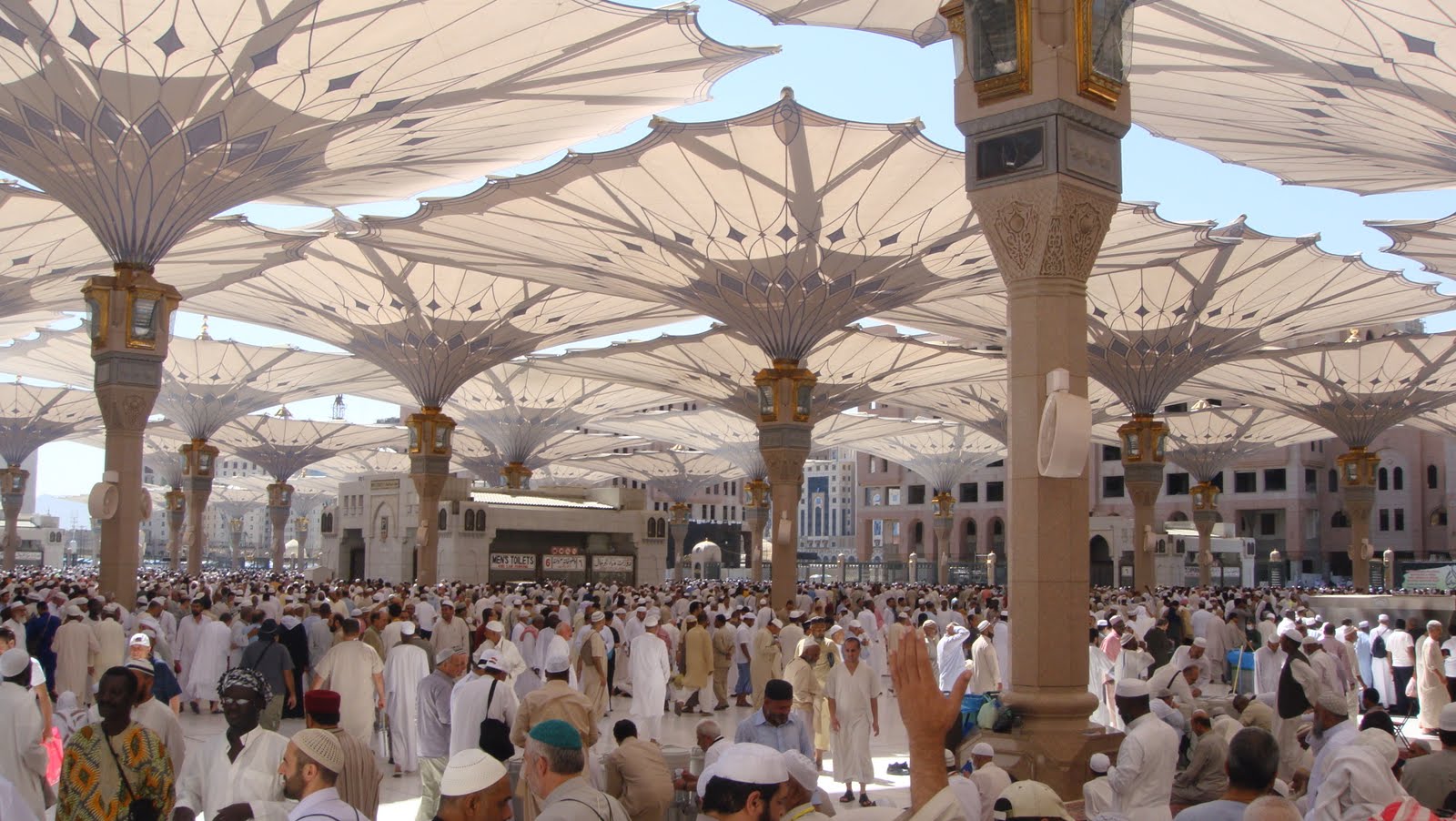
Monday, 2 January 2012

7th Dhul Hijjah 1432 (Thursday 3rd November 2011)

The group, with all its 4 coaches entered Azziziyyah apartments at 2.30am. As we rested our sides on some neat sofas in the basement of the Azzizah apartments, we were served fried chicken and chips!!! And half an hour later, by 3am were back in the coaches on the road to Makkkah Al Mukkarammah.

No rest for us Hajjis, Akluma and I made our own way to the Harem from the drop off which was noted specifically as being on “Ghazzah”, opposite the Masjid al Jinn. We had to be at this place by 7.30am for our return journey to Azziziyyah apartments. Having got to the Harem at 4am, we had 3.5hours to complete Ummrah, and perform Fajr with 3m+ Hajjis. Ok, this is not going to be easy. Abdul Aziz Gate (Gate#1) was closed, typical, just when we thought things can’t get any hard so I recalled there was a basement entrance which I took Akluma through and we entered through various hopping and skipping through people to view the beautiful sacred Baytullah (House of Allah), the Kabbah.


No matter how many times you see this in the media, whether it be on Islam Channel or on your Nikon, it takes nothing from one seeing the Kabbah with ones naked eye. SubhanAllah its magnificent stage for all Muslims to pray in one direction towards, and I am there, answering the call of Allah swt and Ibrahim AS. This is so real!
It was nearly 8.15am when we finished Saee, and therefore we aborted the mission to rush back to the coaches. There were many barbers only meters away from the Mount Marwa as you end the 7th round of Saee. I got a grade 1 @ 10 Riyals and was out of there. Akli and I traced our footsteps back to the where the coach had dropped us off and to our amazement there were other Al Muntada Hajjis waiting there too. So we waited and found our coach, where we happily rested until we arrived at our apartments.

By the time I got back to the apartment It was so very tiring, and then I was on the lookout for a bed to sleep on, so went to the 2nd and 3rd floor and there was no luck, as all beds miraculously had been taken. I then parked myself on the 4th floor where there was a bed free. The room happened to be one of the best rooms in the apartment, with a floor space in the middle that was equivalent to a room in itself. Alhamdulillah for those who wait patiently, Allah does not fail to provide.
I slept like a baby, too much in fact that I missed the dhuhr adaan! So prayed this together with Asr salaat.

The rest of the day was more chilled out, as I got re-energised ready for the commencement of the Hajj days starting tomorrow. Got my Mina bag ready, this was even a smaller bag to the one I took from Medinah, this was the very bare minimum, and it was going to last me all of 6 days!

The waiting game kicked in from 9pm in the evening, as the group waited for the government coaches to arrive to take the group to Mina. So our roommates ended up sleeping until there was any movement....and then as the clocks stroked 1am, we were all out of the apartments and into the buses, which looked like some animal had chewed on the seat fabric. Hey I was not complaining as long as we got to Mina thats all that mattered.

6th Dhul Hijjah 1432 (Wednesday 2nd November 2011)


The last day in Medinah Munawarrah, how short our stay was. This city definitely would not leave our hearts. I went to Fajr with brothers Faisal and Shahed (who very much resembled Syed Ahmed from the Apprentice). We sent Salaams to the Prophet PBUH and the two Caliphs for the last time on this journey.

Departure from Medinah was for 3pm. I therefore did not wish to rush things, so prepared myself for Ihram state (body) before Dhuhr. In order to be in Ihram state I cut my nails, removed any unwanted hair, ensured that I had a wash (can use any soap or shower gel) and opened the two unstitched pieced of white cloth (which look like two ordinary white cotton towels). I prayed my two rakat Tayyihatul Masjid Nafl prayer (the prayer on entering the Masjid) and prayed Dhuhr in congregation and Asr too on my own as I would be travelling later. As I was relaxing having my lunch after Dhuhr, the rest of my room hajjis were getting acquainted with their Ihram towels.

After we boarded coach 3 at 3pm, the count began as usual on the coach, who was here, who was not, and who should not be here! An hour later around 4.30pm we got to Dhul Hulaifah, this was the meeqat point from Medinah to Makkah. This is where I prayed my two rakat salaat and verbalised my intention for Ummrah by saying “Labbayak Allahummah Ummrah Shaban Bibi”. It was an emotional time too, thinking about my Grandmother who I have never met, and know only of her from my Mothers recollection who inadvertently was very young when my grandmother passed away. May Allah rest her in Peace and make the grave easy for her, Ameen.

There was much to appreciate at the service station when we took a break around 11ish; you definitely can smell the toilets before you see them. Queues were long there too, and after 30 minutes of waiting, done my business and prayed Maghrib and Esha combined. The brother from Luton took the Jammat and MashAllah this made the journey so worth it, as he was blessed with a beautiful voice.

We had an overnight travel to Azziziyyah, leaving at 3pm and getting to Azzizah by 2.30am, almost 11.5 hours. I was sitting next to Brother Altaf, he was keeping the rest of us well entertained, especially with his healthy supplements, apricots, nutrition bars, nuts etc. Anyone would think we were going to the Himalayas and back. Though it is best to be prepared than not.
During the 11.5 hours, the brothers were giving the Tarbiyaah its due recognition:

“Labbayk Allahumma Labbayk Labbayka Laa Shareeka Laka Labbayk Innal Hamda Wanni’mata Laka Wal Mulka Laa Shareekalak.”

(Oh My Lord, I am responding to You, there is no partner for You. All praise, grace and dominion belong to You. You have no partners).

http://youtu.be/PTR9IpAQE5o

The above words have been reverberating in the deep ravines of Makkah for centuries. These words that came out from the lips of Prophet Ibrahim (peace be upon him) were inherited by generations after generations. Year after year these words are transmitted in harmony to the heavens through millions of throats with the same rhythm, frequency and amplitude. These sonic waves, originating from every nook and corner of the world, get condensed in the valleys of Makkah and reach Allah.

Hajj is the symbol of absolute submission to the will of God. It is unconditional acceptance of the command of the Creator. The ecstasy experienced by the pilgrim in the presence of his God put him under safe heaven by protecting him from all mundane desires.

MashAllah brother Musleh who was sitting behind me was giving it large with the Tarbiyaah, as was his competitor the black cab taxi brother Hajji (whose name eludes me). It was beautiful saying the Tarbiyah and recognising the unity amongst the brothers on our journey to Makkah. To respond to Allahs call, SubhanaAllah, we on this coach trip were so blessed.

The sisters did mention that they could do better with the Tarbiyyah than the brothers if there were only allowed to say this aloud, though my suspicions are that this was the only time they could not hear themselves talk for a change!:-)

5th Dhul Hijjah 1432 (Tuesday 1st November 2011)

We were early risers at room 1404 with Shaheh bhai taking the lead to get up and go. After Fajr there was no rest and after breakfast we were getting ready to go to Ziyarrah. Coaches were all set, and Akluma and I were on coach 3 of 4 coaches for our group of 200 or so.


We visited Masjid Quba, the first Mosque in Islam where we all prayed 2 rakat nafl salaat as the Prophet PBUH said this is equivalent to the reward of Umrah. I was holding the Al Muntada flag for all Al Muntada Hajjis to gather after their prayers.
Masjid Quba.

The Quba Mosque (Quba' Masjid or Masjid al-Quba, Arabic: مسجد قباء) in the outlying of Medinah in Saudi Arabia, is the oldest mosque in the world. Its first stones were positioned by the Islamic prophet Muhammad on his emigration from the city of Makkah to Medinah and the mosque was completed by his companions.

According to Islamic tradition, offering two rakaʿāt of nafl prayers in the Quba Mosque is equal to performing one Umrah. Quba Masjid is the first mosque built in the history of Islam and was built as soon as Muhammad arrived on the Hijra. Muhammad PBUH used to go there, riding or on foot, every Saturday and offer a two rak'ah prayer. He advised others to do the same, saying, "Whoever makes ablutions at home and then goes and prays in the Mosque of Quba, he will have a reward like that of an 'Umrah." This hadith is reported by Ahmad ibn Hanbal, Al-Nasa'i, Ibn Majah and Hakim al-Nishaburi.


We later visited the famous Uhud Mountain where the Battle of Uhud took place. This is where I recollected the thoughts of the battle between the Muslims and the Mushriks of Makkah . The playback in my mind of the archers, Khalid Ibn Al Waleed (in his Jahilliyah period), Hamzah and the story of Mus’ab Ibn Umayr, and the wounds of the Prophet PBUH took during the battle; it truly brought the tears rolling down my cheeks.

On the way back, I purchased some black seeds, not sure what to do with them, at the time thought it was a good idea as Mother loves Black Seed Oil, it is of course a Prophetic Medicine.

As it was getting close to Dhur, we had to abort plans to visit Masjid Qiblatayn (the Masjid with two Qiblas).

Later in the evening we were packing again, and this time getting our suitcases ready for storage in Makkah. We had to be very measured in what we took to Mina, so I packed the bare minimum. Had already organised my toiletries into Non-ihram and Ihram so knew which were to be taken. Later did not calculate correctly that we were spending more time out of Ihram then in during Mina stay, doh, so had very little “normal” clothes and toiletries for this part of the journey.

4th Dhul Hijjah 1432 (Monday 31st October 2011)

Brother Adeel who I met at my new job a month ago was also staying at my hotel and we met up for Tahajjud prayer around 3.30am. It was great to see him, how Allah swt brought us together in no other than in Medinah. Allah is the best of planners. We stayed right up to the end of Fajr where we embarked on going to the Ar-Rawdah, however this was closed, as people from Fajr where still in there. So we aborted this mission and ended up going back to our hotel for breakfast.

Al Muntada has their first group session at 11am. We were briefed by Shaykh Abu Hanifah on the rights of Umrah. We were also provided a Qur’an by Saheeh International as a gift from Al Muntada. Alhamdulillah. As dhuhr was approaching I went to the Masjid on my own.


Medinah as I recall when I first encountered this city 16 years ago, has not lost much of its appeal, it’s tranquilly is there for all to see and feel. It truly is a welcoming city like no other, and this has been the case right from the days of the Prophets (PBUH) Hijra (migration) to this wonderful city where the Ansar (the people of Medinah) who were so welcoming of the Prophet (PBUH).
After Dhuhr, we were looking for the date market, so we could buy some blessed Ajwa dates (Prophet PBUH favourite dates).

Ajwa (عجوة) is a soft dry variety of date fruit from Saudi Arabia. It is cultivated at Medinah Monawara. A delightfully soft and fruity date with fine texture. The Messenger (Sallallaahu Álayhi Wasallam) said, “Whoever has seven Ajwa dates every morning he will not be harmed on that day by poison or magic.” [Saheeh al-Bukhaaree (5445) (5768) (5769) (5779)].

The Messenger (Sallallaahu Álayhi Wasallam) said, “Ajwa dates are from paradise.” [Tirmidhee (2068) he said hasan Saheeh and it was authenticated by Shaikh al-Albaani].


I went near the entrance of the Ar Rawdan in time for Asr Salaat, and to my astonishment, I could see the barriers to the Ar Rawdah being opened up by the security guards. This meant one thing; I needed to put myself in a place so I could be fortunate to enter this blessed area. And Alhamdulillah 15 minutes later, a 100 meter sprint and the crowd put their breaks on, and looked down at the carpet beneath them; it was the green carpet that the Ar –Rawdan is so re-known for. I was so blessed to have done Nafl salaat and prayed by Sunnat and Fard Asr prayers at this blessed area between the minbar and the Prophets house. I could have stayed for Maghrib but thought it best to give another brother an opportunity to pray here too.

Brother Adeel had advised the date market would be close to Gate 6A. (Tip#2: This would be further to the left of Gate 6A after two crossings; around 10 minutes walk from the gate and should cost around 50-60 Riyals/kilo). See http://abdurrahman.org/umrah/ajwa-dates.html for further information on Ajwa dates.
After Asr I went to the Baqi Cemetary which is located south east of the Prophets Mosque.


Baqi Cemetary
Literally "al-Baqi" means a tree garden. It is also known as "Jannat al-Baqi" due to its sanctity, since in it are buried many of our Prophet's relatives and companions.
The first companion buried in al-Baqi was Uthman b. Madhoon who died on the 3rd of Sha'ban in the 3rd year of Hijrah. The Prophet (s) ordered certain trees to be felled, and in its midst, he buried his dear companion, placing two stones over the grave.

On the following years, the Prophet's son Ibrahim, who died in infancy and over whom the Prophet (s) wept bitterly, was also buried there. The people of Medinah then began to use that site for the burial of their own dead, because the Prophet (s) used to greet those who were buried in al-Baqi by saying, "Peace be upon you, O abode of the faithful! God willing, we should soon join you. O' Allah, forgive the fellows of al-Baqi".

The site of the burial ground at al-Baqi was gradually extended. Nearly seven thousand companions of the Holy Prophet (s) were buried there, not to mention those of the Ahlul Bayt (a).

Among other relatives of the Prophet (s) who were buried at al-Baqi are:
- All of the wives of Muhammad (also known as Mothers of the Believers), including Hafsa, Zainab etc., except for Khadijah bint Khuwaylid and Maymuna bint al-Harith,
- His daughters: Roqayyah and Fatima Zahra (in an unknown grave as she didn't want the people who hurt her to know where she was buried)
- Abbas ibn ‘Abd al-Muttalib, uncle of Muhammad
- Fatima bint Hizam, known as Umm ul-Banin, who married Ali after the death of Fatimah; mother of four children who died defending Hussain ibn Ali in Al-Taff Battle in Karbala
- Hasan ibn Ali, grandson of Muhammad, son of Fatimah and Ali. The Prophet said that Hasan and Husayn bin Ali are the Masters of Youth of Paradise,
- ‘Alī ibn Ḥusayn, known as Zayn al-Abidin, grandson of Fatima Zahra who is the only adult male that survived Al-Taff Battle because he was sick and couldn't fight.
- Muhammad al-Baqir, son of ‘Alī ibn Ḥusayn, the fifth Imam according to Shia,
- Ja’far as-Sadiq, son of Muhammad al-Baqir, the sixth Imam according to Shia
- His aunts Safiya and Aatika, and his aunt Fatima bint al-Asad, the mother of Imam Ali (a).
- The third caliph Uthman was buried outside al-Baqi, but with later extensions, his grave was included in the area.
- In later years, great Muslim scholars like Malik bin Anas and many others, were buried there too.

Thus, did al-Baqi become a well-known place of great historic significance to all Muslims.

After Esha, Akluma and I met up for dinner. She spent some quality time with the Swansea crew and I met up with Adeel and his chums from Al Hiddayya. We managed to sort out some misunderstanding between the two of us as all couples do, InshaAllah this would prove to bring us closer during the rest of the Hajj journey.

In the evening I paid for the Qurbani for my wife and on behalf of my maternal grandmother, my “nani”, Shaban Bibi, who I was performing the Hajj Tamattu for. We provided Al Muntada with the money who would use a 3rd party agent to slaughter on behalf of us. It cost 410 Riyals/sheep (around 70GBP).

The Fifth Pillar Of Islam - Hajj 1432 (2011)

A journey like no other, it is the ultimate journey of the heart. A journey so solitary yet done in unison with over 3 million people, it is truly a spectacular event to answer the call of Allah (swt), to renew one’s faith and Glorify the oneness, the Al Khaliq (The Creator) , Allah (swt).


3rd Dhul Hijjah 1432 (Sunday 30th October 2011)

It was the 3rd day of the sacred month of Dhul Hijjah, and more importantly for my wife, Akluma and I, it was the day of our departure to the sacred land of the Hijaz (known to us today as Saudi Arabia). It is fascinating that this is the only nation that is named after a family, Al Saud.

There was much anxiety in the air, even though this would be my second Hajj, with my first voyage to the Hjaz for Al Hajj 2 years prior in 1430 (2009). I was anxious as if it was my very first travel abroad. Akluma also was very anxious, this would be her first trip to the Hijaz full stop, and with all the Prophetic history surrounding this amazing land, no doubt, what she was feeling was truly normal. With the flight hours away in the early hours of Sunday morning, it was much helped by the winter GMT adjustment which benefitted us by an extra night hour, and co-incidentally (Allahu Alum – Allah knows best) this happened a few hours before our imminent departure. This was one of the many blessings we had experienced on this amazing Hajj journey of the Hearts.

After the usual early morning last minute packing on Sunday, followed by a few hours sleep as we both were excited at the break of dawn we got up ready to be escorted to the airport by our beloved reliable sister Neha. My sister was quick to earn her hasanat (reward), by agreeing to drop us Hajjis to be at Heathrow Terminal 1, which we arrived in good time at 5.45am.

It was sad leaving the Ahlul Ali behind. My dear father was wide awake to send his farewells, and my beloved mother and sister afa said their farewells the night before. Mother did give me a sense of her motherly acknowledgement as I said my Salaams (Peace) on the way out of her room with a nod and a light murmur. It was so handy having an international airport on ones doorstep, something I have to say I take for granted as many over the UK travel to Heathrow for their International departures. Alhamdulillah (All Praise is to Allah), Allah has made this part easy for us.

We were greeted with warm welcome from Al Muntada Hajj group, namely brothers Mustafa and Jameel . The whole process from arrival to check in was very well organised, we were all provided with as much information as possible. I prayed Fajr with some brothers in T1 and collected Riyals from Travelex (Tip#1: if you book online it is far cheaper than on the counter, though you do get a much better rate in SA so best to change a few pounds in the UK).

Whilst we were waiting on the departure lounge, we met the “Swansea crew”, which came as a pleasant surprise even if we did know they were in our group. I was introduced to brothers Arjun and Hasan, with the former being related to my wife, this in itself was a blessing having booked independently not knowing of either party booking with Al Muntada. I was re-assured that my wife had someone she knew which will enable her to feel comfortable with the whole Hajj journey.
As we were about to board our plane, which was 2 hours delayed. I got speaking to Brothers, Bhodrul, Waqeel and Imran. MashaAllah they were solid brothers. What touched me was the re-collection of the story of the Battle of Uhud by Bhodrul bhai in respect to the great courageous Sahaba Mus’ab Ibn Umayr.

Mus’ab Ibn Umayr – Battle of Uhud
At the Battle of Uhud, Mus'ab realized the great danger facing the Prophet PBUH. He raised the standard high and shouted the takbir. With the standard in one hand and his sword in the other, he plunged into the Quraysh forces. The odds were against him. He was suddenly surrounded by enemy forces. A Quraysh horseman moved in close and cut off his right hand. Mus'ab was heard to repeat the words: "Muhammad is only a Messenger. Messengers have passed away before him," showing that however great his attachment was to the prophet himself, his struggle above all was for the sake of God and for making His word supreme. His left hand was severed also and as he held the standard between the stumps of his arms, to console himself he repeated: "Muhammad is only a Messenger of God. Messengers have passed away before him." Mus'ab was then hit by a spear. He fell and the standard fell. The words he repeated, every time he was struck were later revealed to the Prophet and completed, and became part of the Quran.

It had been noted that 10,000 angels came to his Janaza (Islamic funeral). This re-collection brought tears to the eyes of Bhodrul Bhai and the rest of us could not but be moved by this story. It just shows the level of emaan the companions of the Prophet (PBUH) had, and what love for our beloved Prophet (PBUH). SubhanAllah (Praise be to Allah).

I met a former Tajweed student, Altaf Abbas from our Tayyibun Class of 2006. Incidentally he was really good friends with another good brother I knew, Liaquete Khan who I play indoor 5 aside football with regularly. It was a further co-incidence that he just happened to be sitting next to me on the plane too.
Another blessing was having Shaykh Abu Saed, from Willesden on our Hajj group. The Shaykh, was also well known in the Islamic circles, and more recently on Islamic Q&A at 8pm on sky channel 813 – Islam Channel. It was great to have him, as he was one my favourite Q&A shaykhs, and some brothers and I would watch the Q&A programme with much anticipation to see this Shaykh which brought so much joy and much talk the next day at work. Alhamdulillah. The Shaykh came with his wife and his two daughters. He also happens to come with his brother in law, Shahed Choudhury, who was also my room-mate in Medinah and Makkah.

Whist we sat in the plane getting ready to depart, there was announcement that the lavatory was blocked from the previous Hajj group, well no doubt this is a hazard and will take time to clean out. Our flight, a BMI chartered flight from Heathrow to Medinah took approximately just over 6 hours, which was good. Got to our 4 start hotel, Hotel Dar al Eeman Grand Hotel which looking over our 3 day stay here, found that this was the residence for many of the well known UK Hajj groups, such as Al Hidayya, Amaana Tours, Nabeel Travels etc. There were Shaykhs from all parts of the World there too, as far afield as Canada (Shaykh Ala).

Shahed bhai came with us to the Prophets Masjid. After Esha, prayer Shahed bhai and I went to send Salaams to the Prophet PBUH, Abu Bakr RA and Umar Ibn Al Khattab RA. I met up with Akluma after as we took a stroll around the magnificent Medinah Al Munawarrah Masjid at 11pm (after our buffet dinner –yes we needed to burn some carbs off!). Akluma saw a great opportunity to enter the Masjid, which was closed after Esha to Sisters. MashaAllah, managed to get into the sisters section of the Medinah Al Munawarrah at the early hours of Monday morning approximately 12am. And how blessed she was to find the Swansea Crew of sisters, whom she managed to squeeze herself into the Ar Rawdah an Nabawiyah (“Gardens of Paradise”). This is a very difficult to pray salaat in this place in the best of times and more so during the Hajj season.

Ar-Rawdah an-Nabawiyah
The heart of the mosque houses a very special but small area named ar-Rawdah an-Nabawiyah, which extends from Muhammad's (s.a.w) tomb to his pulpit. Pilgrims attempt to visit and pray in ar-Rawdah, for there is a tradition that supplications and prayers uttered here are never rejected. Entrance into ar-Rawdah is not always possible (especially during the Hajj season), as the tiny area can accommodate only a few hundred people. Ar-Rawdah has two small gateways manned by Saudi police officers. The current marble pulpit was constructed by the Ottomans. The original pulpit was much smaller than the current one, and constructed of palm tree wood, not marble. Ar-Rawdah an-Nabawiyah is considered part of Jannah (Heaven or Paradise).
It is prescribed for the one who visits the mosque to pray two rak’ahs in the Rawdah or whatever he wants of naafil prayers, because it is proven that there is virtue in doing so. It was narrated from Abu Hurayrah that Muhammad (s.a.w) said: “The area between my house and my minbar is one of the gardens (riyaad, sing. rawdah) of Paradise, and my minbar is on my cistern (hawd)” Narrated by al-Bukhaari, 1196; Muslim, 1391.

And it was narrated that Yazeed ibn Abi ‘Ubayd said: “I used to come with Salamah ibn al-Akwa’ and he would pray by the pillar which was by the mus-haf, i.e. in the Rawdah. I said, ‘O Abu Muslim, I see that you are keen to pray by this pillar!’ He said, ‘I saw that the Prophet (peace and blessings of Allaah be upon him) was keen to pray here.’” Narrated by al-Bukhaari, 502; Muslim, 509.

Further information on the Prophets Mosque can be found on: http://www.3dmekanlar.com/en/prophets-mosque.html

It appeared Shahed bhai who was staying with me and Faisal bhai in the triple room, may have got lost after Esha, as he managed to spend a large sum of riyals on taxi fares to come to the hotel, even though it was only 5 minutes from the Prophets Masjid. Funny enough all 3 of us were Bangladeshi, so we all brushed up on our mother tongue in Medinah!

Saturday, 31 December 2011

I am back in 2012, stronger InshaAllah


It has almost been a year since my last post. The Year 2011 has been an eventful year and one that I shall never forget. It had its ups and downs, Alhamdullillah it was a year that I came out saying ShukrAllah.

It has started off with me attending a few Islamic courses organised by the Al Kauthar Institute and it was so nice to be doing this with Zawjaty (my wife). Masha'Allah.

I was unfortunate or fortunate should I say to be made redundant in a role I started a year ago! Just shows that no one can be too sure of job security in today's economic climate, it definitely is unpredictable. With this I had more time to spend with my dear family, ShukrAllah.

It was during this time, that my dear Father became really ill, and was admitted into hospital, later to be diagnosed with renal failure. And over a course of a few days, the family had to make a decision on the very high possible option of dialysis being taken as a means of aiding his kidneys. My father, having agreed to being put on dialysis, was feeling the effects of having dialysis three times a week.

I later secure another role, Alhamdulillah, not the perfect job, this does not exist I had realised after 15 years of working. It simply comes down to taking the right opportunities that present oneself with, that's how to become a winner. InshAllah with Tawwakul it helps aid any decision whether it is job or otherwise, knowing the reason why you are doing the job, activity, linking this back to your deen and more so your aakirah. This I feel gives much motivation.

I have also been privileged to have come across Muhammed Faris - The Founder of Productive Muslim, and he has great practical advice to fulfilling ones potential whether it be Islam, Family, Personal, Community etc. I will Insha'Allah look to providing more resource on this site, based on my experience of the tips from ProductiveMuslim.com over the course of 2012, so again watch this space.

Last year I was blessed to have taken my wife to Hajj, this was to be my second Hajj Alhamdulillah. Please keep your eyes peeled for a post on this magnificent journey of a lifetime, it is not to be missed.

There are only snippets of my 2011 year. Insha'Allah there will be much more beautiful experiences and more importantly E-man Boosts and Appetizers for the year to come.

Sunday, 16 January 2011

Awakening to Dumb-bells


Awakening to Dumb-bells

Date: 6th July 2010
This was a remarkable day in many ways, having not had much sleep, missing Fajr at the due time once again; I got up feeling very tired. May Allah forgive me for this and May He increase my Iman and provide me with much Hidayyah to get up for Fajr, Ameen.

It was 09.30 and I had a 10.00 Personal Fitness session at the gym which I only joined for 4 weeks in the lead up to my wedding. This was one of the 1/3 free personal fitness sessions as part of the package. For breakfast, I had bran flakes with strawberry cereal and tea and lead my 5 minute stroll to the gym. Having done that I met Andrew my personal fitness trainer in the gym which after the initial consultation which he took reading of my body measurements and weight, which read as:
Height: 169cm; Weight: 73kg; Body Fat %: 22%; Waist: 92cm; Hip: 98 cm

The stats were not as bad as I had envisaged, though I felt I can work on these numbers in preparation for my big day, my wedding day on 25th July 2010. I was given a run through of 4 main workouts for me to cover. Having done the Bench-press with dumbbells, followed by the squats and dead lift. Having done this in quick concession, we now moved on to the lat pull down, and by this time I was feeling very faint, if anything felt like throwing up big time.

This was so unusual for me, and did not know what to do, so I asked Andrew if I can sit down. Within a space of 2 minutes, my vision became severely impaired, felt like my legs had been swept, and was really feeling like my head had been hit hard. I was almost going into unconsciousness mode drifting back in as soon as someone asked me a question.

Within a short space of time, I had four or five people gathered round me asking me all types of questions (I was later told so could not recall now), ensuring I was not closing my eyes for my own safety. I did not know at a point where I was, what time it was or if it was all a bad dream. My mind was on what will happen to me, and is this my time now up in the dunya, so close to finally going the extra mile to complete my deen, with a special abd Allah has blessed me with, I was feeling like I lost out big time.

I was then “chair lifted” to the consultation room where paramedics came after 15 minutes or so, where they took my blood pressure which was a low 101/61. I was escorted to the ambulance parked on the high street, 15-20 minutes of checkups and was given the all clear by the parameds’. I was given the option of going to hospital for blood tests which I did not take up. I intended to go to see my Doctor to tell them of this episode in the gym.

I went back into the gym to collect my bag, showered went to the steam room for 7 minutes and was on the way home. It was 12.40 by the time I got home. I was shattered; my head was feeling like it had been hit by a hammer, this was the case throughout the whole day. Had some sleep at around 5pm but it did very little good.

I received a text from my better half to be, and the text was number 63 and 64 as part of the 99 Names of Allah Project countdown to the wedding. And Allahu Alum, the Names today were, Al Hayy (the everlasting) and Al Qayyum (the sustainer of life), SubhanaAllah the beauty and irony if one may want to call it that after what happened today.

I came across this quote, on one of my daily reminder mails today:
Ma’n ibn ‘Awn once said
‘How often has a person faced a new day but yet failed to complete it, and how often has a person waited for tomorrow but yet failed to reach it? Were you to look carefully at the matter of death and its paths, you would have come to hate having hopes and its delusions.’

Abu Hatim said
‘The one reason which leads the smart one to place this world in its proper place, abandon relying upon it and seeking that which has been decreed for him of eternal life and everlasting blessing, is abandoning long hopes and remembering that death is something which can come at any given moment. This is because long hopes have forever severed the necks of men just like the mirage… it disappoints whoever places his hope in it, and it deceives whoever sees it

May I take a lesson not to waist idle time, use it wisely, use it to benefit myself and others and always have in my mind, what deeds have I to account for when my time is up. Death may arrive at any moment, so I should not be disillusioned by my environment and my surroundings (and no matter how many kgs I can begin to bench-press!).
For those reading this, InshaAllah may it serve as a reminder to begin right now to start using our time effectively in preparation for the aakirah.
By Abdul Muhid Ali

Sunday, 14 November 2010

AddThis Social Bookmarking Sharing Button Widget

AddThis Social Bookmarking Sharing Button Widget: "AddThis is a free way to boost traffic back to your site by making it easier for visitors to share your content"

Saturday, 13 November 2010

Qurbani, Qurbani, Qurbani...

Qurbani, Qurbani, Qurbani...


Now that this is the "Qurbani" season, I wanted to look into the Fiqh of Qurbani. Having always had my parents, notably Padre doing this for me, over the last few years I have done this for the family, though was rather following what my Padre did. Now my curiousty now to find out what the Fiqh ruling is on Qurbani, I have found this excellent thorough answer on Sunni Path.

http://qa.sunnipath.com/issue_view.asp?HD=1&ID=8369&CATE=175

The Fiqh of the Qurbani of Eid-ul-AdhaAnswered by Ustadha Shaista Maqbool

Question:salams. I pray this finds u in the best of afiya and imaan.
Could you please explain the fiqh of the qurbani given at the end of Hajj, in terms of (a) Who is it wajib upon? (b) Does the husband have to pay for his wife's qurbani, or is she legally responsible to pay for herself? (c) How does one make-up missed qurbani's? (d) Is is wajib for parents to pay for their children, and is this payed individually or can it be included with the parent's niya?
Answer:


In the Name of Allah, Most Merciful, Most Kind.

The udhhiya is the sacrifice which is made during the Days of Sacrifice - from the the first day of Eid al-Adhha, i.e. 10th Day of Dhul Hijjah, until the last day - the end (i.e. sunset) of the 12th of Dhul Hijjah. The best is to do the sacrifice on the first day.


It is obligatory on every sane, mature (one who has reached puberty) Muslim who is not a traveler, who is rich (meaning who owns wealth which is beyond one's need equal to (or more than) nisab = 72 grams of gold or 100 grams of silver), and who has come upon the Day of Sacrifice of Eid.

Therefore, a wife who fulfills the latter conditions is obliged to pay for herself, though children who have not reached puberty are not. If one fulfills the above, it is obligatory on him to sacrifice one goat or sheep, or a seventh of a camel or cow. (In other words, one goat or sheep fulfills one person's obligation, and one camel or cow fulfills seven peoples' obligation.)

Conditions of the validity of the sacrifice


1-If the animal is a camel - it is at least 5 years old; if a cow, it is at least 2 years old, if a sheep or goat, it is at least 1 year old.
2-It does not have any defects e.g. blindness in one or both eyes, or a limp which prevents it from walking to the place of sacrificing, or that it is very skinny, or it has an ear (or most of the ear) cut off, or its tail is cut off, or other deficiencies, worst than those mentioned.
3-That the sacrifice be made after the 'Eid prayer, such that if it is done before, it is considered merely a slaughter, and the person stills owes a sacrifice.

From the sunnah acts of sacrifice:
-To eat from the meat of the animal he has sacrificed. It is also sunnah for him to give some of it as charity (to the poor), and to store some, and to give some as a gift to the wealthy.

-To not cut the animal's hair or nails when the month of Dhul Hijjah comes.
It is sunnah to do the slaughter by oneself, if capable, and to say and do what the Prophet, the greatest of peace and blessings of Allah upon him, did.
Abu Dawud narrated in his Sunan: "The Prophet, peace and blessings of Allah upon him, sacrificed on the day of sacrifice...When he turned the faces (of the animals for sacrifice), he said: [Arabic text:]

إني وجهت وجهي للذي فطر السماوات والأرض على ملة إبراهيم حنيفا وما أنا من المشركين إن صلاتي ونسكي ومحياي ومماتي لله رب العالمين لا شريك له وبذلك أمرت وأنا من المسلمين اللهم منك ولك عن محمد وأمته باسم الله والله أكبر ثم ذبح
'I turn my face to the Creator of the of the heavens and the earth, on the religion of Ibrahim, worshipping only Allah, 'and he [Ibrahim] was not of the idolators'. Indeed my prayer, my rituals, my life and my death are for Allah, the Lord of Worlds, He has no partner, and with this I was commanded and I am from the Muslims. O Allah! [It is] from You and to You, on [behalf of] Muhammad [peace and blessings of Allah upon him] and his ummah. In the Name of Allah, Allah is the Greatest.'
Then he slaughtered."

-If one is incapable of slaughtering by oneself, he gives the animal to someone who is and he witnesses the slaughter.
-It is preferable (mustahab) for the one who is sacrificing to give the skin of the animal in charity. He may use it for himself, but he may not sell it or use it to pay the slaughterer with it.
-It is not valid to give the price of the sacrificial animal instead of actually slaughtering it. This is because here the sacrifice in itself is the objective, contrary to zakah - where money may be given instead of the actual food - because the aim is to aid the poor.
-It is okay to delay slaughtering the animal to the third day if there is an excuse such as rain, after this it is not allowed.
[References from Al-Hadiyyah al-'Alaiyyah of Imam 'Ala al-Din son of Ibn 'Abideen and from Arkan al-Islam of Dr.Wahbi Sulayman Ghawiji, a contemporary Hanafi scholar.]

If one did not make the sacrifice in previous years in which it was obligatory on him, he must give the price (rather than slaughtering an
animal) of a sacrificial animal in charity, as stated in the Hashiyah of Ibn Abdieen. See Mufti Muhammad Kawthari's response on this topic (under Giving Qurbani -
http://qa.sunnipath.com/issue_view.asp?HD=1&ID=8333&CATE=15) for more detail.

Back Again for a Heart 2 Heart

Salaam Bloggers, InshaAllah you are all well. I have taken a little sbatical from the Blogg. Now that I am back I am rearing to go with some articles that have tickled by taste buds over the last few months.

First of these is, an article by Shaykh Muhammad Maulud on by Shaykh Muhammad Maulud.


Alchemy of the Heart: Shaykh Muhammad Maulud
Translated into English by Shaykh Hamza Yusuf

We gratefully acknowledge and thank the Zaytuna Institute
for giving us the permission to reproduce this.

This is an edited transcription of excerpts from the audio tapes of the course Shaykh Hamza gave based on his translation of Shaykh Muhammad Maulud's Matharatul Qulub: The Alchemy of the Heart. This class took place in Hayward, California in 1999.
Part 1: Shaykh Hamza's Preview to the Course
The Heart
Allah subhanahu wa t'ala says, "On that day nothing will benefit the human being, neither wealth nor children, only the one who brings Allah a sound heart." A sound heart is one that is free of defects and spiritual blemishes. Though the spiritual heart is centred in the physical heart, the heart being referred to here is the spiritual heart, not the physical heart. In ancient Chinese medicine, the heart houses what is known as "chen" which is "a spirit." The Chinese character for "thinking," "thought," "love," "virtue," and "intending to listen" all contain the ideogram for the heart. In fact, in every culture in the world, people use metaphors that deal with the heart; in English, we call people who are cruel, "hard-hearted people." There is also the idea of having "a cold heart" and "a warm heart." People who do not hide their emotions well "wear their hearts on their sleeves." When deeply affected, we say, "he affected me in my heart" or "in my core." In fact, the English word "core" means "inner most," and in Arabic, the equivalent "lub" comes from the Latin word, meaning "heart." Thus, the core of the human being is indeed the heart. The word "courage" also comes from the same root word as for "heart" because courage is centred in the heart. The most ancient Indo-European word for heart means "that which leaps." The heart leaps or beats in the breast of man. For example, people say, "my heart skipped a beat" in reaction to seeing somebody. Many such metaphors are used for the heart.

Three Types of People

The ancients were aware of the spiritual diseases of the heart, and this is certainly at the essence of the Islamic teaching. One of the first things the Qur’an does is define three types of people: the mu'minun, thekafirun, and the munafiqun. The mu'minun are people whose hearts are alive while the kafirun are people whose hearts are dead. The munafiqun are people who have a disease or a sickness in their hearts; thus, Allah subhanahu wa t'ala says, "In their hearts is a disease, and they were increased in their disease." This is also in accordance with another verse: "When their hearts deviated, Allah made them deviate further." When somebody turns away from Allah subhanahu wa t'ala, Allah subhanahu wa t'ala causes them to deviate even further from the truth.

The Heart and the Brain

The actual physical heart in our breast beats about 100,000 times a day, pumping two gallons of blood per minute, 100 gallons per hour, 24 hours a day, seven days a week, 365 days a year for an entire lifetime! The vascular system that sends this life-giving blood is over 60,000 miles long: it is more than two times the circumference of the earth. Furthermore, it is interesting to note that the heart starts beating before the brain is formed; the heart begins to beat without any central nervous system. The dominant theory was that the central nervous system is what is controlling the entire human being from the brain, yet we know now that in fact the nervous system does not initiate the heartbeat. It is actually self-initiated; we would say, it is initiated by Allah subhanahu wa t'ala.

The heart is the centre of the human being. Many people think the brain is the centre of consciousness, yet the Qur’an clearly states, "They have hearts that they are not able to understand with." According to the Muslims, the centre of human consciousness is the heart and not the brain itself, and it is only recently that human beings have learned there are over 40,000 neurons in the heart; in other words, there are cells in the heart that are communicating. Now, it is understood that there is two-way communication between the brain and the heart: the brain sends messages to the heart, but the heart also sends messages to the brain. The brain receives these messages from the heart, which reach the amygdala and the thalamus. The cortex receives input from the amygdala and thalamus that it processes to produce emotion; the new cortex relates to learning and reasoning. These processes are recent discoveries, and although we do not fully understand them, we do know that the heart is an extremely sophisticated organ.

According to the hadith, the heart is a source of knowledge. The Prophet, sallallahu 'alayhi wa sallam, said that wrong action is what irritates the heart. Thus, the heart actually knows wrong actions, and this is one of the reasons why people can do terrible things, but, ultimately, they are affected negatively. In Crime and Punishment, the brilliant Russian author Dostoevsky indicates that crime itself is the perpetrator's punishment because human beings have to live with the result of their actions: their souls are affected. When people do something against the heart, they act against the soul, and that actually affects human beings to the degree that they will go into a state of spiritual agitation, and people will use many ways to cover this up. This is what kufur is: "kufur" means "covering up." To hide their agitation, people use alcohol, drugs, and sexual experimentation; they also seek power, wealth, and fame, taking themselves into a state of heedlessness, submerging themselves into the ephemeral world which causes them to forget their essential nature and to forget their hearts. Thus, people become cut off from their hearts.

Wrong Actions Sicken the Heart

One of the things about being cut off from the heart is that the more cut off from the heart one becomes, the sicker the heart grows because the heart needs nourishment, and heedlessness starves the spiritual heart. When one goes into a state of unawareness of Allah and the akhira, one becomes unaware of the infinite world in relation to the finite world, unaware that we are in this world for a temporary period. When we look at the infinite world in relation to the finite world, suddenly our concerns become focused on the infinite world and not on the finite world. On the other hand, when people are completely immersed within the finite world, believing that they will be here forever, believing that they will not be taken to account for their actions, this action in and of itself ultimately leads to the spiritual death of the hearts. However, before it dies and becomes putrid and completely foul, the heart will show many symptoms. These are the spiritual diseases of the hearts.

Shubahat and Shahawat: Two Types of Diseases

There are two types of diseases of the heart. The first are called shubahat, and these are diseases that relate to understanding. For instance, if somebody is fearful of his provision from Allah, afraid he will not get his food for the day, then there is a disease in his heart because a sound heart has complete trust in Allahsubhanahu wa t'ala, and a sick heart has doubt. For this reason, a sound heart does not worry. It is the nafs(ego), shaytan, hawa (caprice), and dunya (the love of this ephemeral world) that lead to this state of fear or of anxiety. The heart in [and] of itself is an organ designed to be in a state of stillness, but the stillness will only come about by the remembrance of Allah subhanahu wa t'ala. The Qur’an states, "Isn't it by the dhikrof Allah that the heart is stilled?" This is what the heart wants: it wants to remember Allah subhanahu wa t'ala. When Allah is not remembered, the heart goes into a state of agitation: it goes in a state of turmoil, and it becomes diseased because it is not being fed. Just as we need to breathe because cells need life-giving oxygen and if we stop breathing, cells die, similarly, the heart also needs to breathe, and the breath of the heart is the remembrance of Allah subhanahu wa t'ala. Dhikr is what feeds and nourishes the heart. The company of good people is the food and exercise of the heart. All of these things are necessary for the heart to be sound and healthy, and this is basically the purpose of Revelation. The Qur’an has come to remind people that our hearts need nourishment. Thus, Allah subhanahu wa t'ala tells us that the human being who will be in a good state in the next world is the one who brings a sound heart.

When we are born, we enter the world in a state of fitra: the original inherent nature of the human being; then we learn to be anxious. We learn anxiety from our mothers, fathers, and society. Thus, the Qur’an says that the human being is created in a state of anxiety (hala'), and the one group of people who are removed from this state of anxiety are the musallin: the people of prayer. This "prayer" is not the five daily obligatory prayers; rather, it is the prayer of people who are always in a state of prayer (dhikr); they are always in a state of connection with Allah subhanahu wa t'ala, and this is the highest station. This is the station of people who are not diverted from the remembrance of Allah subhanahu wa t'ala by buying, commerce, or anything else. They are the ones who remember Allah subhanahu wa t'ala, as the Qur’an states, "standing, sitting, and reclining on their sides." These are the people who are not the people of heedlessness (ghafla).

The second type of the diseases of the heart is called shahawat, and these are the base desires of the self. For instance, food and sex are shahawat; they are appetites. These become diseases when they grow out of proportion from their natural states. In Islam, we have a method or a means by which our hearts can be remedied and return to their sound state again. The dhikr that the Prophet sallallahu 'alayhi wa sallam did more than any other dhikr was "Oh Turner-Overer of the hearts, make my heart firm on your deen," and it is important that Muslims be reminded of this.

The Text: Mat-hartul Qulub

In Arabic, "Mat-hara" is ism makaan (a noun of place), and it means "a tool of tahara (purification)," and that is what Mat-hartul Qulub is. This text is the alchemy of the heart: it explains how to transform the heart. Mat-hartul Qulub was written by a great scholar, Shaykh Muhammad Maulud al-Musawir al-Ya'qubi from Mauritania. He was a brilliant scholar of West Africa who mastered all of the Islamic sciences as well as the inward sciences of Islam. He wrote this didactic poem in order to teach people the means to purify their hearts because he looked around and realized that everybody he saw had a diseased heart. Though he recognized the benefit in learning the abstract sciences of Islam, such as grammar, rhetoric, and logic, he felt that people may not have a great deal of need for that knowledge given the fact that on the Day of Judgement, the heart is the only thing about which we will be asked. The state of our hearts is the only thing that may benefit us because "actions are by intentions" as the hadith states. Since all our actions are rooted in intentions, and the place of intention is the heart, every action we do is rooted in our hearts. Thus, in reality when we are asked about our actions, we are asked about the intentions behind the actions, and given the fact that intentions emanate from the heart, what we are actually being asked about is the human heart. When Shaykh Muhammad Maulud realized this, he said that suddenly Allah subhanahu wa t'ala inspired him to write this text, and he based it upon many of the previous texts that had gone before, such as the last book of the Ihya 'Ulumudin by Imam Abu Hamid al-Ghazzali.

Rectification Begins with the Self

If we look at the world today, the tribulations, the trials, and every war that we have, we will see that every bit of human suffering is rooted in human hearts. The reason people are aggressive against other people is due to diseases of the heart: covetousness, the desire to conquer, the desire to exploit other people, and the desire to steal their natural resources are all from diseases of the heart. A sound heart cannot commit such acts. Every murderer, every rapist, every idolater, every foul person, every person showing an act of cruelty has a diseased heart because these actions emanate from diseased hearts. If the hearts were sound, none of these actions would be a reality. Therefore, if we wish to change our world, we cannot go about it by attempting to rectify the outward; rather, we change the world by rectifying the inward because it is the inward that precedes the outward.

In reality, everything that we see outside of us comes from the unseen world. The phenomenal world emerges from the unseen world, and all actions emerge from the unseen realm of our hearts. Thus, if we want to rectify our actions, we must first rectify our hearts. Dr. Martin Luther King, Jr., the famous American preacher and civil rights activist, said that in order for people to condemn injustice, they have to follow four stages: the first stage is that they must ascertain that injustices are indeed being perpetrated. People must point out the injustices, and in his case, it was injustices against the African-American people in the United States. The second stage is to negotiate: people must go to the oppressors and demand justice. If the oppressors refuse, then Dr. King said that the third stage is self-purification. He said that we must ask ourselves, are we ourselves wrongdoers? Are we ourselves oppressors? The final stage is to take action once we have looked into ourselves.

One of the things the Muslims of the modern world fail to recognize is that when we look at all of the terrible things that are happening to us, we often refuse to look at ourselves and ask ourselves, why are these things happening to us? If we ask that in all sincerity, the answer will come back in no uncertain terms that this is all from our own selves. We have brought all of the suffering upon ourselves. This is the only empowering position that we can take, and this is the Quranic position. Allah subhanahu wa t'ala says quite clearly that He places some of the oppressors over other oppressors because of what their hands were earning. According to Fakharudin ar-Razi's explanation, radi Allahu 'anhu, this verse means that whenever there is oppression in the earth, it is a result of other people's oppression. Thus, those people who are being aggressed upon are being oppressed because of their own oppression. However, this is obviously with the exception of tribulation. There are definitely times when the mu'minun are tried, but if they respond accordingly with patience and perseverance, Allah subhanahu wa t'ala always gives them victory.

The Impure Oppress and the Pure Elevate

There is no doubt that the Prophet sallallahu 'alayhi wa sallam and the sahaba were being oppressed when they were in Makkah, but Allah subhanahu wa t'ala later gave them victory. Within 23 years, the Prophetsallallahu 'alayhi wa sallam was not only no longer oppressed, he had conquered the entire Arabian peninsula, and all of the people who had previously oppressed him were begging him for mercy. Even though they deserved to be recompensed with punishment, the Prophet sallallahu 'alayhi wa sallam forgave them, and this is the difference between somebody whose heart is pure and somebody whose heart is impure. The impure people oppress, and the pure people not only forgive their oppressors, they actually conquer them by the power of Allah subhanahu wa t'ala, and then they elevate them. This is what Muslims must recognize: the only solution to all of our problems is that we have to purify ourselves, and this is whatMat-hartul Qulub is about; it is a book of self-purification. If we take this book seriously, work on our hearts, and actually implement what we learn from it, we will begin to see changes in our lives, around us, and within our own family dynamics. It is a blessing that we have this book and that this teaching still exists in our community. All that is left is for us to take this teaching upon ourselves and to take it seriously.

Medicine for the Diseased Heart

If you use the techniques that are given by the imams, you will see results. However, it is just as the prescription that the doctor gives you: the doctor can only write the prescription; he can give you the medicine, but he cannot force you to take the medicine. It is left for us to take the medicine. The imams have given us the medicine: our teaching is there; it is clear; it does work; and we can change ourselves with it. If we do, Allah subhanahu wa t'ala has promised that we will be rewarded in this world and in the next. Thus, all that is left for us to do now is to go through these diseases and then set out to implement their cures in sha Allah.